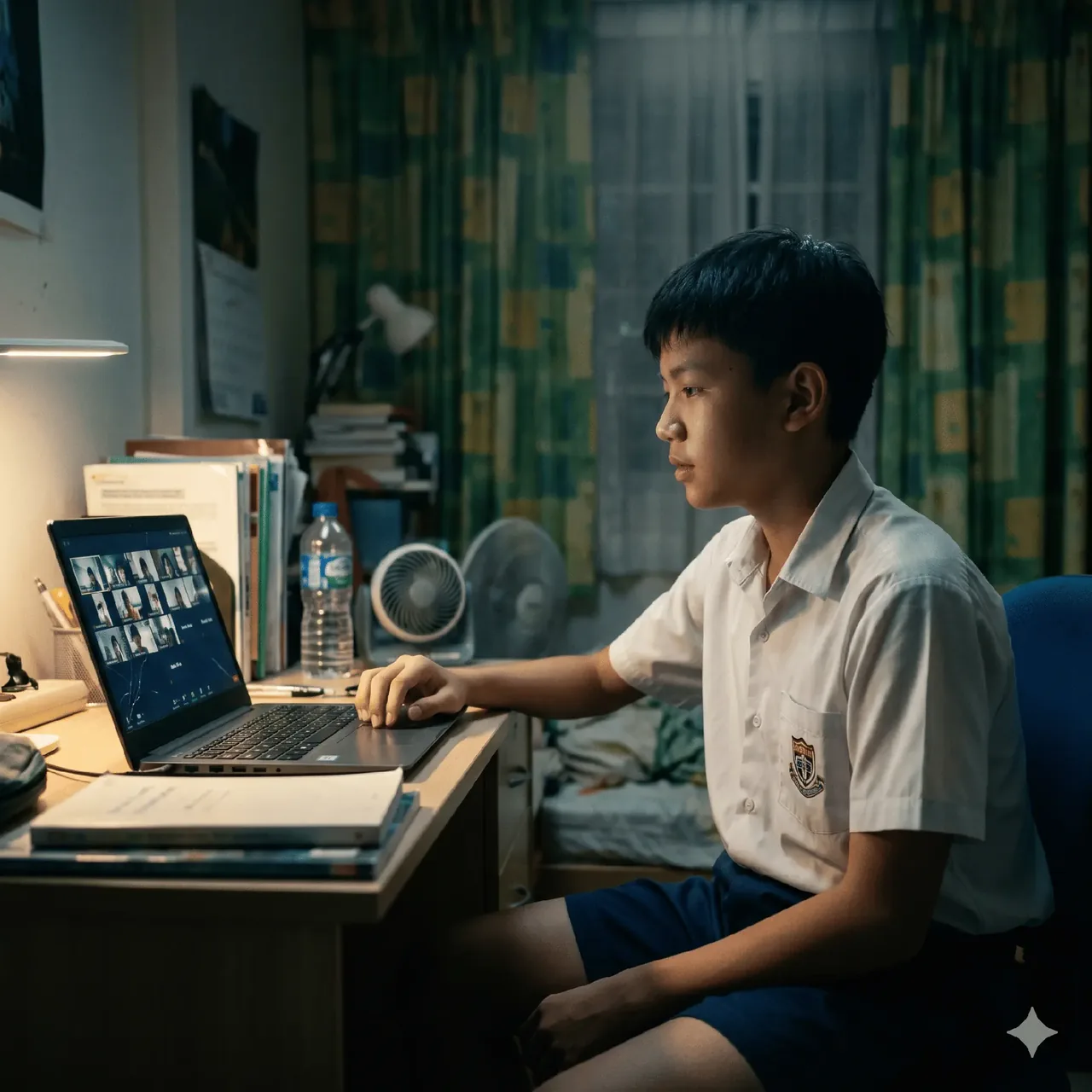
You might hear that online tuition is a godsend that saves hours of commuting, while other parents swear it's a fast track to their child zoning out behind a black screen. Both observations are entirely valid. The shift to digital platforms hasn't fundamentally changed how students process information; rather, it amplifies their existing learning habits and structural bottlenecks.
Here is a breakdown of what the research and expert guidance reveal about the effectiveness of these different learning modalities in Singapore.
1. Academic Performance: The "Divergence" Effect
Research indicates that online learning is not inherently less effective than face-to-face instruction, but it amplifies a student's existing learning habits.
- Knowledge Acquisition: Studies, including those conducted by the American University of Beirut regarding the transition to Home-Based Learning (HBL) and remote readiness, found that online delivery did not negatively impact cognitive performance or knowledge acquisition, particularly for mature or naturally disciplined students.
- The Competency Gap: Conversely, a study of Temasek Polytechnic's Virtual School of Business examining online learning perceptions found a distinct split: "stronger" students were highly receptive to virtual platforms, utilizing the flexibility to learn at their own pace. "Weaker" students, however, often viewed online modules as an added burden, struggling without the immediate, physical structure and forced accountability of a traditional classroom.
2. Online Learning vs. Physical Private Tuition
Private tuition in Singapore is heavily relied upon to navigate high-stakes exams like the PSLE and O/A-Levels. The choice between online and in-person tuition usually hinges on behavioral factors rather than purely academic ones.
The Advantages of Online Tuition:
- Time and Energy Efficiency: Online classes eliminate commute times, leaving students with more energy to balance long school hours and CCAs.
- Psychological Safety: Many students report feeling more comfortable asking questions in a virtual 1-to-1 setting, as the barrier of physical proximity is removed, creating a lower-pressure environment.
The Advantages of In-Person Tuition:
- Immediate Feedback: Tutors can read facial expressions, monitor body language, and spot confusion instantly. This non-verbal communication is often lost over Zoom.
- Benchmarking and Accountability: In a physical group tuition setting, students can naturally benchmark their progress against peers. Furthermore, in-person lessons minimize the digital distractions present in a home environment and force a dedicated routine.
3. The School Environment: Engagement and Socialization
While online platforms excel at delivering content, traditional schools provide elements that are difficult to replicate virtually.
- Multi-Dimensional Engagement: Researchers note that student engagement has three components: cognitive, behavioral, and emotional. While online platforms handle cognitive delivery well, Singaporean teachers report significant challenges in monitoring behavioral and emotional engagement through a screen.
- Holistic Development: Traditional schooling remains unmatched for hands-on learning, spontaneous collaboration, and the soft-skill development required for future workplace environments.
The Push for Hybrid Learning
Educational consensus in Singapore is moving away from treating this as a strict "either-or" scenario. The effectiveness of the medium depends almost entirely on the learner's profile:
- Online-first is highly effective for self-motivated students, those with heavy extracurricular commitments, or those needing convenient, targeted 1-to-1 academic patching.
- Face-to-face remains necessary for students who struggle with time management, require hands-on practice, or thrive on the social energy of a classroom.
Looking forward, the educational landscape is embracing a blended approach. Supported by initiatives like the Ministry of Education's EdTech Masterplan 2030, institutions and tuition centers are increasingly offering hybrid models—combining the geographical flexibility of digital platforms with the interactive depth of physical classrooms.
You don't have to lock into a single modality for every subject. Evaluate the specific demands of each and map the format that provides the path of least resistance for your child's weekly schedule.
If you've audited your child's learning profile and decided that cutting out the commute is the right move this term, we can help you skip the manual search. You can use our free directory at MatchaTutor to filter through hundreds of verified options. Just apply the "Virtual" location filter to instantly compare centres that offer remote or hybrid models, so you can find a structural fit without the guesswork.
Frequently asked questions
How can I tell whether online tuition is working?
Choose a specific goal before the trial, such as explaining a fraction method or starting a comprehension answer independently. Afterwards, try a fresh task using the same skill. Also ask whether your child could hear clearly, follow the pace and get help when confused.
Does online tuition require a highly independent child?
It requires some practical preparation, but independence should not be treated as an all-or-nothing label. Check who helps the child join the session, how the tutor notices confusion and what happens between lessons. A clearly structured online class may offer more guidance than an unstructured face-to-face lesson.
What should I ask an online tutor before booking?
Ask about the regular teacher, class size, lesson platform, how working is shared and how individual questions are answered. Clarify device requirements, privacy arrangements, missed lessons and any recording access. A demonstration of the actual lesson process is more useful than a promise that everything is interactive.
Should we switch online just to save travelling time?
Include the saved journey in your comparison, but check whether the home setting supports participation. Look at noise, connection reliability, screen setup and competing commitments. A convenient timeslot is not a good fit when your child spends the lesson struggling to hear or repeatedly needing technical help.