
When parents weigh AI tools against tuition, the natural question is whether AI is 'accurate enough' to handle Secondary or JC content. The good news? For most standard syllabus questions, it absolutely is.
But accuracy is the wrong question to lead with. The decision parents are actually making is whether the invisible support tuition quietly provides like accountability, pacing, and structured discipline can be replaced by a chatbot subscription. Tuition's true value was never just about dispensing correct answers.
This article breaks down where AI stands today, where Singapore-tailored AI platforms fit into the picture, and why you might want to hold off on firing your tutor just yet.
Part 1: Where AI Has Arrived
The capability ceiling has shifted
For most Secondary and JC-level academic content, modern AI reliably produces correct, well-explained working, not just final answers. Hallucinations on standard syllabus topics like A-Math heuristics and Chemistry stoichiometry have dropped sharply over the past two years. Models now walk through step-by-step working much the way a patient tutor would, including the intermediate steps students typically skip. Treating AI as a competent first-responder for homework-level queries is no longer wishful thinking; it's an accurate read of where the technology currently sits.
The massive cost and availability gap
AI offers something tuition structurally cannot:
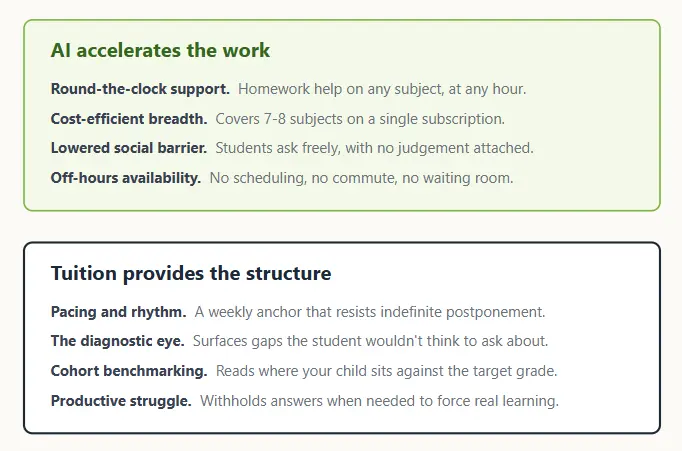
- Round-the-clock access across every subject. A single monthly subscription sidesteps the per-subject, per-hour calculus that makes tuition expensive to scale across seven or eight subjects.
- Zero scheduling friction. No commute, no booking, no fixed weekly slot to defend against CCAs or remedial classes.
- No per-question accounting. A student asking a tutor the same clarifying question three times feels socially expensive. Asking an AI does not.
If your child's real obstacle is getting timely help when they need it, this is a meaningful improvement on the status quo. Whether that is actually their bottleneck is a separate question we come to in Part 3.
The best thing that has happened to introverts
There is a quieter benefit that often goes unnoticed: AI removes the social cost of asking. A student who would never raise their hand in a 12-pax tuition class, for fear of looking slow or being judged by classmates, will happily ask an AI the same question five times until it clicks. For introverted or self-conscious learners, the gain isn't smarter answers; it's that more questions are finally being asked at all.
Customisation parents can build themselves
Tools like ChatGPT Projects, Claude Projects, and Gemini Gems let you create a customised "workspace" inside the AI. You upload reference material once (the MOE syllabus, past papers, your child's notes) and add a custom instruction like "explain in stages and prompt before giving the final answer", and the AI carries that context into every future conversation in that workspace. Done well, a generic chatbot starts to behave like a Singapore-context tutor.
The honest caveat is that getting this right is an iterative process. Custom instructions often need several rounds of tweaking before the AI consistently responds the way you want, and the cycle of testing, adjusting, and re-testing takes more time and patience than most parents have appetite for. That's part of why the next category exists.
Part 2: Tailored AI Solutions
A pre-built environment instead of a DIY one
A growing category of Singapore-specific AI tutoring platforms (such as Tutorly.sg, Geniebook's Intelligent Features, and even MOE's own free AI assistants available through Student Learning Space) packages this setup work for you. They typically bundle MOE-aligned topic notes, exam-format question banks, and pre-set instructions, organised around the topics your child is actually studying rather than around open-ended chat. The interface is generally friendlier than a raw chatbot and structured the way a Singaporean student would naturally revise.
For parents who don't want to DIY a setup with Projects or Gems, this category is the managed-service version of AI tutoring.
The trade-offs behind the convenience
Like any curated environment, the convenience involves trade-offs worth understanding:
- Less room to customise. If the AI is not responding the way you'd like (too quick to give answers, pitched at the wrong level, not Socratic enough), you can't open the hood and adjust the underlying instructions the way you can with Projects or Gems. You work with what the platform decided.
- Price is one variable, not the only one. When comparing the monthly cost against a general AI subscription (or against the free SLS option), it's worth also looking at the breadth of subjects covered, monthly usage limits, and which underlying AI model is powering the platform, since these all shape what you're actually getting for what you pay.
It isn’t a black or white "tailored is better" or "general is better". It's a choice between convenience and curation on one side, flexibility on the other. Different families will weigh that differently.
Part 3: What AI Struggles to Deliver
The pacing function
Tuition's most underrated value isn't the content it delivers. It's the rhythm it imposes. A weekly, externally-anchored slot protects study time from being indefinitely postponed. For most students, the real bottleneck isn't access to explanations; it's the discipline to engage with material consistently between exam cycles. AI is fully on-demand, which also means it's fully on-skip. For students who struggle to self-direct (which is most students), the structural scaffolding is the service, not a side effect.
The diagnostic eye
A skilled tutor reads what the student isn't saying: the misunderstanding behind the question, the gap that hasn't surfaced yet but will at the next assessment. AI answers what's asked. A good tutor surfaces what should have been asked but wasn't.
A common example is a student rushing ahead before ensuring the core foundational topics of the subject are mastered.
Calibrated benchmarking
Experienced tutors carry a cohort-level benchmark. They've seen what an A1-trajectory student looks like in March of Sec 4, and what a borderline pass looks like, across many years and many students. AI can mark an essay against a rubric, but it cannot tell you whether your child is realistically on track for their target JC cut-off or polytechnic course. That is precisely the question parents and students structurally cannot answer themselves, and it usually only gets asked too late.
The crutch risk
AI's frictionless answering creates a structural risk that's easy to underestimate. Students can complete homework without retaining understanding, and the gap only surfaces at exams. Durable learning happens during productive struggle, which a too-helpful AI can short-circuit. A tuition teacher can deliberately withhold the answer to force the grappling; an AI is designed to give one immediately. Used unsupervised, AI can produce a quiet trajectory where homework looks fine for months and exam grades stagnate without an obvious cause. AI as a tuition replacement is only safe if your child is already disciplined enough to use it the harder way.
So Where Does This Leave You?
AI has genuinely changed what's possible at the content and homework level. For most students, though, it does not replace what tuition was structurally providing.
The students who can extract full value from AI as a tuition replacement are a minority: those already self-directed enough to initiate sessions, articulate their gaps, and resist the temptation to take the shortcut. For these students (often, though not always, the academically stronger ones), AI is a genuine accelerator and the cost savings are real.
For most students, the bottleneck was never access to explanations. It was the structure, the accountability, and the human diagnostic eye that an external adult provides over time. None of that gets solved by a better tool.
In practice, the version that works for most families is AI as a layer, not a replacement: tuition handles pacing, diagnosis, and exam-trajectory calibration, while AI handles homework support, off-hours questions, and bridging into subjects where formal tuition isn't worth the per-hour cost. The decision shifts from "which one" to "what does each do best for my child".
If you're weighing how tuition fits into your child's setup, our other articles on tuition walk through how to read centres, formats, and fit. Our directory itself stays a free filter at MatchaTutor.sg when you're ready to look for the best tuition centres and teachers.
Frequently asked questions
Can AI replace my child's tuition completely?
Do not decide solely because a chatbot solves a worksheet. List what the current lessons provide, then check which parts your child can manage without them. A student who still needs help starting, planning or recognising mistakes may need human support even when explanations are readily available.
How do I tell whether AI is helping my child learn?
Ask them to attempt the question first and request a hint rather than the full solution. Later, close the chat and try a similar question independently. Being able to explain the method on fresh work is more useful evidence than a neatly completed page produced with continuous assistance.
Can I trust an AI tool to mark examination answers?
Treat its marking as provisional feedback. Compare comments with the correct syllabus, available marking guidance and the teacher's feedback. OpenAI notes that ChatGPT study mode can still make mistakes. A confident explanation is not proof that the suggested mark or method is correct.
Do we need a paid AI subscription to try this approach?
Start with a specific learning task and an approved tool already available to your family or school. Test whether it gives useful hints and whether your child can work independently afterwards. Compare paid options only after identifying a real limitation, rather than assuming a subscription will create a study habit.
Can a primary-school child use ChatGPT independently?
ChatGPT is not intended for children under 13. Users aged 13–17 need parental permission. For educational use involving under-13s, the adult must conduct the interaction, according to OpenAI's age guidance. Do not give a younger child an adult account to use independently.