
If you've been staring at terms like G3 Math, G2 Math, G3 Additional Math, and G2 Additional Math wondering how they all fit together, you're in good company! The secondary mathematics system was restructured in 2024 under Full Subject-Based Banding, and the new band labels combined with the long-standing split between base Math and Additional Math at Sec 3 make the system confusing to navigate from the outside.
In this guide, we walk through exactly how the five Math syllabuses connect, who is eligible for each, and what each one prepares your child for. We make it so easy that by the end, you’d be able to explain it yourself!
Part 1: How the system is structured
The G1/G2/G3 bands replaced streaming in 2024
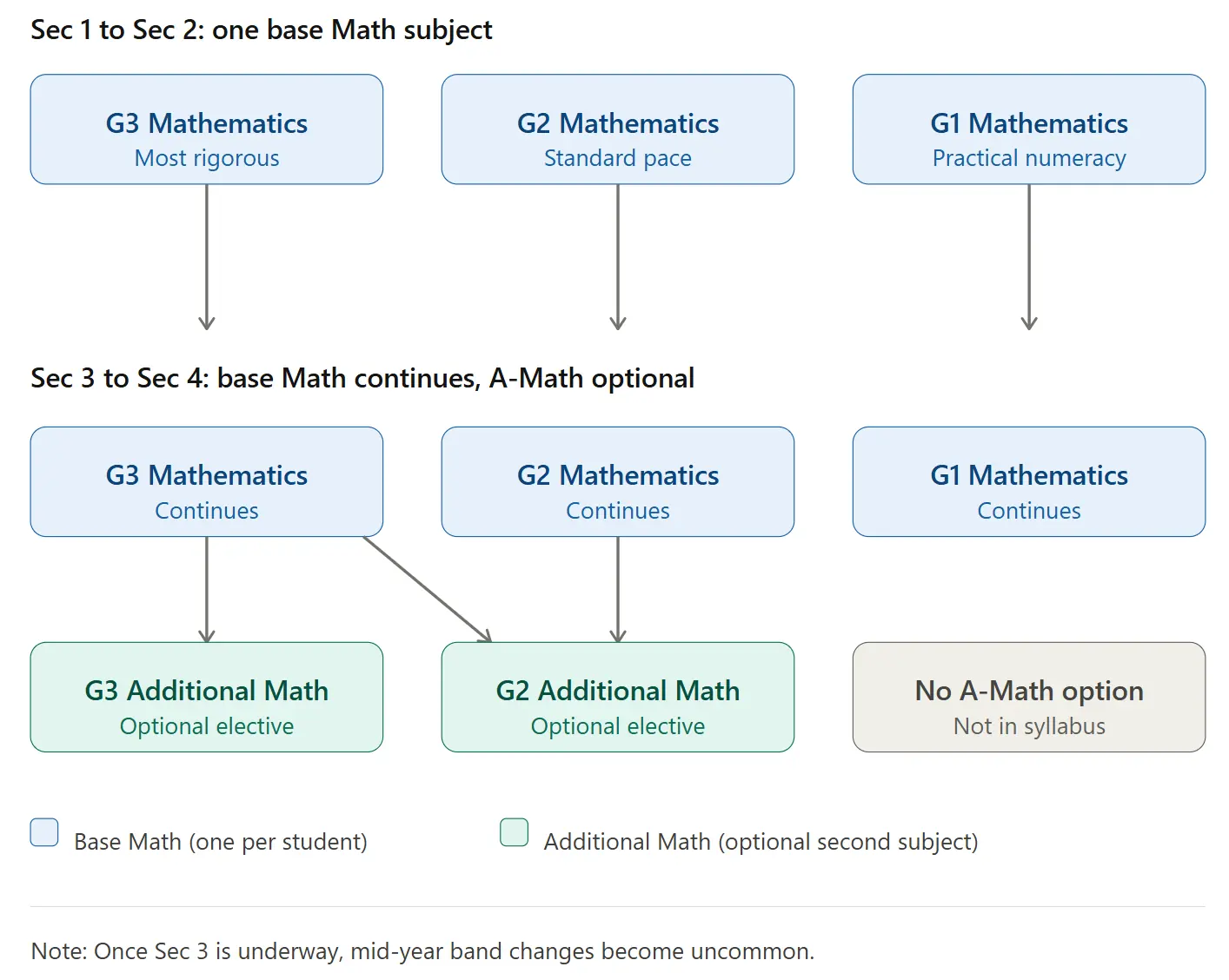
Since 2024, MOE has replaced the old Express, N(A), and N(T) streams with subject-based bands labelled G3 (the most demanding), G2, and G1. Crucially, these bands are applied subject by subject rather than across the whole timetable, so a student can be in G3 for one subject and G2 for another. For Math specifically, your child's PSLE results determine their starting band, but Full Subject-Based Banding means they can move up or down at the subject level if their school assessments support it. One important nuance: band changes are most realistic as early as possible, before Sec 3 begins. Once Sec 3 is underway, band changes become uncommon because the syllabus depth and pace differ enough that catching up partway becomes overwhelmingly difficult.
Sec 1 to Sec 2: one Math, one band
From Sec 1 through Sec 2, every student takes exactly one Math subject (G1, G2, or G3) and these three syllabuses cover the same broad strands (Number and Algebra, Geometry and Measurement, Statistics and Probability) but at different depths and paces. This is the simple stretch of the journey. The decision-heavy moment arrives at the end of Sec 2, when the curriculum splits.
Sec 3 onwards: the curriculum splits
At Sec 3, two things happen at once: students continue with their base Math (G1, G2, or G3) for two more years, and they gain the option to add a second Math subject called Additional Mathematics, available at G2 or G3 level. This optional second subject is the reason the upper-secondary system has five Math syllabuses instead of three.
Part 2: The three base Math syllabuses
These are the three tiers your child has already encountered in Sec 1 and Sec 2, and which continue through Sec 3 and Sec 4.
- G3 Mathematics (formerly O-Level "E-Math"). G3 Mathematics is the most rigorous of the three base syllabuses and is the standard mathematics qualification for students on a JC pathway. It covers set notation, matrices, coordinate geometry, vectors, trigonometry beyond right-angled triangles, and standard deviation. It is also the structural foundation that Additional Math is built on top of — a point we return to in Part 3.
- G2 Mathematics (formerly N(A) Math). G2 Mathematics covers most of the same topics as G3 but at a gentler pace and lighter depth, omitting some of the more abstract strands at the standard four-year route. The chapters they missed, notably vectors, matrices, and set notation, can be picked up if they take a Sec 5 year. A strong G2 Math result keeps the polytechnic pathway open and, with a Sec 5 year, leaves the JC pathway possible too.
- G1 Mathematics (formerly N(T) Math). G1 Mathematics is designed for students on the post-secondary vocational pathway, focusing on practical numeracy. They will become familiar with interpreting bills, computing simple and compound interest, reading transport schedules, working with household finance alongside core algebra and geometry foundations. The syllabus is built around making math useful in everyday life rather than preparing for further academic mathematics, which directly shapes the Additional Math eligibility rules we cover next.
Part 3: The two Additional Math syllabuses
What Additional Math actually is
Additional Mathematics is a separate elective subject that sits alongside base Math rather than replacing it. A student who offers A-Math sits two distinct Math subjects at the national exam. It is widely perceived as the harder of the two, because it introduces calculus, advanced trigonometry, polynomial theory, surds, and (at the G3 level) exponential and logarithmic functions.
Who is eligible: the prerequisite logic
Eligibility for Additional Math is determined by which base Math band a student is in, because A-Math is built on top of base Math content rather than parallel to it.
- G3 Additional Math pairs with G3 Math. The G3 A-Math syllabus explicitly assumes G3 Math content as prior knowledge. For example, the plane geometry topics in G3 A-Math footnote that congruent and similar triangle properties are properties learnt in G3 Mathematics. A student would find G3 A-Math difficult without the G3 Math foundation underneath.
- G2 Additional Math is open to both G2 and G3 Math students. The G2 A-Math syllabus opens with quadratic functions, simultaneous equations, surds, and calculus which assume the algebraic foundation built in G2 Math, and which G3 Math students cover comfortably too. A G3 Math student may therefore opt for G2 A-Math as a lighter alternative to G3 A-Math.
- There is no "G1 Additional Math." Only five Math syllabuses exist in the MOE secondary curriculum, and a G1 A-Math is not one of them. The G1 Math syllabus focuses on practical numeracy rather than the advanced algebraic foundations A-Math demands, so the gap between G1 Math content and A-Math content is structurally too wide to bridge.
In short, G1 students take one Math subject; G2 and G3 students may take one or two, depending on whether they add A-Math.
G3 Additional Mathematics (formerly O-Level A-Math)
G3 Additional Math is the standard A-Math qualification and the de facto entry ticket for H2 Math in Junior College. It covers differentiation, integration, advanced trigonometric identities, binomial expansions, exponential and logarithmic functions, partial fractions, and coordinate geometry of circles. H2 Math, in turn, is a hard prerequisite or strong expectation for a wide range of university courses including most Engineering, Computer Science, Economics, and the quantitative Sciences, making G3 A-Math carry weight far beyond the SEC grade itself.
G2 Additional Mathematics
G2 Additional Math is the lighter version of A-Math, available to G2 students with strong mathematical aptitude. It covers a reduced version of the calculus and trigonometry content and omits the exponential and logarithmic strand at the standard four-year route. A G2 student who takes Sec 5 can pick up the missing G3 A-Math topics, but usually would be expected to progress to JC and elect for H1 Math.
Conclusion
The upper-secondary Math system looks more complicated than it actually is once you separate the two questions it's really asking: which band for the base Math subject (G1, G2, or G3, determined by PSLE posting and adjusted via Subject-Based Banding), and whether to add Additional Math on top.
One last point worth knowing as you look at tuition options. Centres handle these subjects in very different ways. Some run mixed classes that group G1, G2, and G3 students together and differentiate within the room, while others run dedicated classes for each band. Similarly, most centres run A-Math and base Math as two separate programmes a student signs up for individually, while a handful combine both into a single integrated programme. Neither approach is structurally better but knowing which one a centre uses lets you ask the right questions about pacing and class composition before committing.
Frequently asked questions
Does Additional Mathematics replace ordinary Mathematics?
No. Additional Mathematics is a separate subject studied alongside Mathematics. When considering it, account for both sets of lessons, homework and assessments. Ask to see the school's complete subject combination rather than treating A-Maths as a simple upgrade to the existing Maths class.
What is the difference between G3 Mathematics and G3 Additional Mathematics?
Mathematics provides the main secondary Maths foundation. Additional Mathematics extends into areas such as more advanced algebra, trigonometry and calculus. Compare a few actual questions from each syllabus: enjoying routine calculation does not necessarily tell you how your child feels about longer algebraic reasoning.
Can my child take Mathematics and Additional Mathematics at different levels?
Ask the school which combinations it offers and how eligibility is assessed. Do not assume that every theoretically possible pairing is available on its timetable. Take your child's recent Maths work to the discussion so the recommendation considers their algebraic understanding as well as the overall grade.
Is Additional Mathematics compulsory for H2 Mathematics in JC?
Requirements and preparation expectations differ between colleges. Before rejecting or dropping A-Maths, check the intended college's subject guidance for your child's intake and ask about any bridging arrangements. Meeting general JC admission requirements is a separate question from being prepared or eligible for a particular H2 subject.