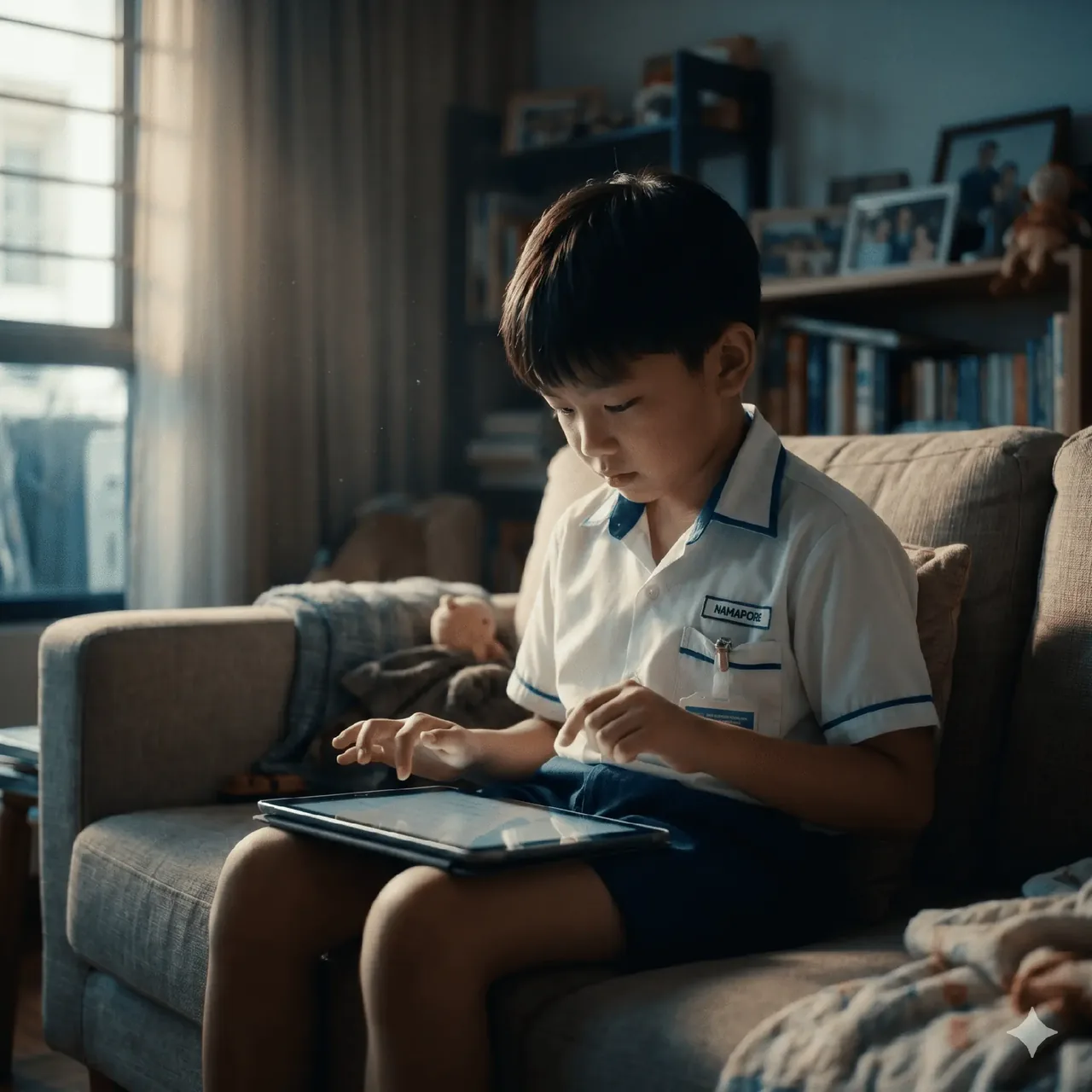
It is widely accepted that screens are an unavoidable part of modern Singaporean childhood, from daily Student Learning Space (SLS) assignments to weekend video calls with grandparents. And while it is easy to feel overwhelmed by the sheer volume of digital exposure, the goal for parents is no longer about enforcing a strict zero-screen policy. Instead, the focus has shifted toward building a healthy "tech diet" that aligns with a child's developmental milestones. This article breaks down the latest pediatric research on screen time and maps out practical, age-appropriate guidelines to help you navigate your child's digital habits without the daily battles.
The Early Years (Ages 3-5) – Bridging the Digital Gap
For preschoolers, the brain is rapidly building its foundational architecture, relying heavily on real-world, physical interactions. While educational apps frequently market themselves as academic head-starts, young children process this digital information differently than adults do.
- The one-hour baseline: Both the World Health Organization (WHO) and the American Academy of Pediatrics (AAP) strongly recommend capping sedentary, non-educational screen time at just one hour per weekday for this age group.
- The 2D to 3D disconnect: Research shows that children under five struggle with the "transfer deficit"—meaning they have distinct difficulty connecting a concept seen on a flat screen to a physical object in the real world.
- The power of physical play: Hands-on activities like stacking blocks, drawing, or molding clay remain the most effective ways to develop the fine motor skills required for Primary 1.
- The co-viewing solution: When screens are used, pediatricians highly recommend sitting alongside your child rather than leaving them to navigate the device alone.
You can easily turn a passive cartoon into an active learning moment by asking simple questions about what is happening on screen, naturally bridging the gap between digital content and your child's developing language skills.
Lower Primary (Ages 6-9) – Protecting Cognitive Stamina
As your child enters primary school, their attention span becomes a critical resource for managing longer MOE worksheets and sustained classroom instruction. The type of media they consume heavily influences this cognitive stamina.
- The two-hour recreational ceiling: For primary schoolers, global health guidelines advise keeping non-educational, passive screen time to under two hours a day, explicitly separating "homework time" on SLS from "entertainment time" on YouTube.
- Fragmented focus: Fast-paced, passive entertainment demands very little cognitive effort but highly stimulates the brain, making it harder for children to transition back to slower, sustained tasks like reading or math.
- Active vs. passive engagement: Interactive educational tools or strategy games require problem-solving and intentional participation, which are far less taxing on a child's attention span than aimless scrolling.
- Hold off on digital: Brain imaging reveals that highly animated e-books can actually overstimulate a child, suppressing the imaginative networks used for deep reading comprehension.
To build the vocabulary and comprehension needed for lower primary literacy, sticking to traditional print books for bedtime reading provides the optimal level of mental engagement, saving the tablets for interactive daytime learning.
Upper Primary (Ages 10-12) – Navigating Social Mechanics
The transition into the PSLE years comes also with a massive shift in how children interact with technology. This change is driven less by a simple desire to play games and more by a profound biological drive for peer connection.
- The dopamine loop: Around age 10, the brain's reward centers become highly sensitive to social validation. The "likes," streaks, and notifications built into modern platforms trigger dopamine releases that make disengaging genuinely difficult for a preteen.
- The social hub: Class WhatsApp groups and multiplayer games often serve as the primary spaces where peer relationships are maintained and navigated outside of school hours.
- The "Goldilocks" balance: Interestingly, psychological studies suggest that completely banning screens can lead to social isolation. A moderate approach (around one to two hours of curated recreational use) actually supports better peer attachment than total restriction.
Instead of fighting the biological pull of peer connection, you can collaborate with your child to set clear boundaries, such as allowing social screen time only after revision is complete, helping them build necessary time-management skills.
Physiological Realities – Sleep and Eyesight
Beyond academic focus and social dynamics, a child's digital habits directly impact their baseline physical health. Managing their tech environment is often the most straightforward way to improve their daily energy levels.
- Circadian disruption: The blue light emitted by tablets and phones forcefully suppresses melatonin, tricking the brain into staying awake and disrupting the deep sleep required to consolidate memory.
- The 60-minute curfew: To protect your child's sleep architecture, pediatric sleep specialists uniformly advise a strict household boundary to power down all screens at least an hour before bedtime.
- The myopia factor: Singapore’s Health Promotion Board consistently highlights the link between prolonged near-screen work and high rates of childhood myopia, emphasizing the vital need to balance screen time with outdoor play.
Protecting your child's restorative rest is as simple as keeping all devices out of the bedroom overnight, removing the temptation to scroll when they should be sleeping.
Conclusion
Guiding a child through the digital landscape is an ongoing process of observation and adjustment. By setting clear boundaries, engaging with their media, and modeling healthy phone habits yourself, you provide a structured environment where they can safely navigate the digital world and thrive in the classroom.
If part of that navigation involves looking for academic support that fits your child's specific learning style, we built MatchaTutor to help. You can use our free directory to easily filter and compare over 1000 tuition centres across Singapore, putting all the information in one place.
Frequently asked questions
What are Singapore's recommended screen-time limits for children aged 3–12?
Under MOH's Grow Well SG guidance, children aged 3–6 should have less than one hour daily outside school. For ages 7–12, the limit is less than two hours daily unless related to schoolwork. The younger group includes six-year-olds.
Does required schoolwork count in the same way as leisure screen use?
MOH's guidance distinguishes school-related use. That does not make the rest of the day unlimited: plan homework, leisure and time away from devices separately. Refer to the age-specific guidance rather than labelling every app educational to avoid a limit.
Should a child aged 12 or younger have social media access?
MOH advises against social media access and unrestricted mobile-device access for children aged 0–12. Parent-selected material viewed together is different from giving a child an unrestricted personal account.
How can we change screen habits without arguing about every minute?
Agree on a simple routine for when leisure use starts and ends, which activities remain device-free and what your child can do instead. Give notice before stopping an activity. Review what is proving difficult together; a rule that changes unpredictably is harder for everyone to follow.