It is a familiar scenario in Singapore: your child’s schedule is packed with enriching activities like Robotics, Art Club, or Symphonic Band, but they simply aren't drawn to sports. As a parent, you might quietly wonder: if my child isn't getting much physical extra-curricular time, are they missing a crucial window for physical development? The reality is that foundational motor skills are not just about athletic prowess; they are deeply intertwined with a child's cognitive capabilities, emotional regulation, and lifelong physical literacy. Even with standard PE classes, children who lack unstructured movement opportunities often face gaps in their physical confidence.
Here is what the latest kinesiology and pediatric research reveals about supporting the physical development of a less sports-inclined child, and how you can seamlessly integrate movement into their existing routines.
Why Your Child Might Be Struggling (Even With PE)
Your child's schedule might be packed with coding classes, piano lessons, or tuition, but if they aren't drawn to physical activities, it is rarely due to pure laziness. Often, biology and social dynamics are quietly working against them.
During the rapid, uneven growth spurts of early adolescence, children experience mismatched physical and emotional development, making highly visible, competitive sports feel deeply intimidating rather than fun.
- The Biological Mismatch: Kids in early adolescence grow at wildly different speeds. In a single class, physical development varies drastically, meaning some kids feel smaller, weaker, or physically awkward compared to their peers. This biological reality makes highly visible, competitive sports feel unfair and embarrassing, naturally prompting them to withdraw.
- The Growth Spurt Factor: Sports science research utilizing the Athletic Skills Model emphasizes that physical expectations should be based on a child's individual growth spurt, not their exact chronological age. However, because PE classes often revolve around competitive sports, a child whose body is still catching up might feel like they are simply "bad at sports." In reality, they are just on a different timeline, but this competitive pressure frequently leads to a mental dread of exercise.
If you notice this hesitation, a collaborative approach works best to reduce anxiety. Instead of pushing traditional sports, try framing movement as an adventure or a project. You might suggest activities like weekend hiking, pitching a tent for a camping trip, or even building and flying a kite together—activities that build motor skills without the pressure of a scoreboard.
Turning Screen Time into Skill Time (Exergaming)
It’s a classic Singaporean parenting dilemma: wrestling the iPad or Nintendo Switch away from a child who actively resists going downstairs to play. But not all screen time yields the same developmental trade-offs.
Interactive video games that require whole-body movement bypass the performance anxiety of traditional sports, offering a highly stimulating, low-stakes environment that accidentally builds profound physical and cognitive skills.
- Clinically Proven Gains: Meta-analytical data demonstrates that "exergaming" (like Nintendo Switch Sports or Just Dance) significantly improves gross motor function and balance abilities in healthy pediatric cohorts.
- Neurological Upgrades: Beyond mere physical movement, playing physically interactive digital games drives significant neuroplasticity. Studies show this quantifiably enhances executive functions, specifically rapid decision-making and inhibitory control.
Rather than viewing this as a compromise, it helps to recognize the structural value: swapping passive scrolling for active, full-body gaming is a scientifically valid form of physical and neurological development for kids who prefer to stay indoors.
The Surprising Link Between "Geeky" Hobbies and Math Grades
Your child might prefer building robots, drawing, or practicing the piano over kicking a football. Turns out — these preferences are wonderful for their physical development.
Fine motor skills (the precise, coordinated movements of the hands and fingers) are neurologically wired directly to spatial intelligence and academic performance, meaning non-sporting hobbies are crucial developmental tools.
- The Math Connection: Quantitative meta-analyses consistently demonstrate a powerful statistical correlation between early visual-motor integration and subsequent mathematical ability.
- The Musical Advantage: Interventional studies on musical training reveal that youths playing instruments like percussion or piano develop superior fine motor skills, rhythm perception, and hand-eye coordination compared to their non-musical peers.
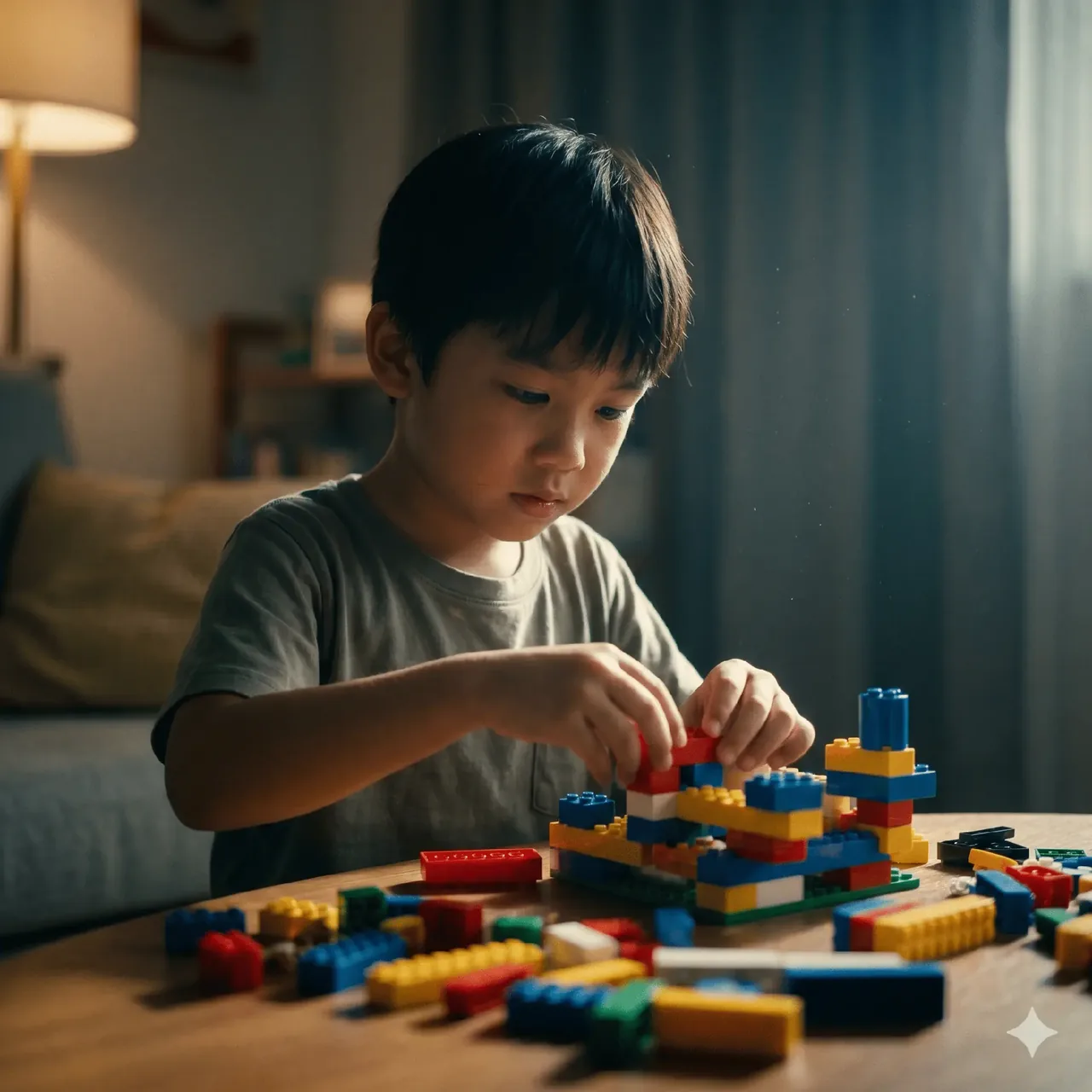
If your child avoids sports but loves creating, heavily encourage complex Lego sets, block-based robotics, or clay modeling. This effectively trains their fine motor dexterity and visual-spatial mapping while keeping them engaged in what they genuinely enjoy.
Why "Go Play Outside" Doesn't Work for Tweens (Especially Girls)
You tell your 13-year-old to go get some fresh air at the HDB playground or fitness corner, but they complain there’s nowhere for them to actually hang out. This resistance is often rooted in urban design, not defiance.
Modern public spaces are often accidentally designed for aggressive, male-dominated competitive play (like basketball courts and skate parks), making teenage girls and kids who prefer other hobbies feel highly alienated and exposed.
- The Drop-off in Participation: Research indicates a precipitous, statistically significant drop in girls' participation in outdoor physical activities around age 13. This is heavily driven by the spatial marginalization of public parks being perceived as "boys' places."
- The Equipment Bias: Urban design researchers note that outdoor facilities like skate parks, BMX tracks, and multi-use game areas overwhelmingly cater to boys, severely restricting unstructured physical activity for everyone else.
Understanding that the neighborhood park might legitimately feel too intimidating or uninviting right now allows you to adapt. Consider how you can adjust your own family weekends to guarantee they get the movement without feeling exposed in hyper-competitive public spaces.
The "STEP" Hack for Stress-Free Family Activity
Even if you adapt your weekend plans to avoid hyper-competitive public spaces, family games like badminton or cycling can still end in frustration when a child who isn't naturally sporty feels they just "aren't good at it" and wants to quit.
Instead of constantly correcting a child's form—which increases their anxiety and mental load—parents can subtly change the rules, the equipment, or the space to guarantee the child succeeds.
- Eliminating Internal Corrections: Proponents of the Constraints-Led Approach (CLA) demonstrate that using external cues (e.g., "hit the shuttlecock toward the big tree") instead of internal corrections (e.g., "bend your wrist more") allows a child's neurobiology to naturally figure out the movement without stress.
- Modifying the Environment: Adjusting the "Equipment" constraint—such as utilizing a balloon instead of a rigid ball, or a racquet with a larger sweet spot—drastically reduces the fear of impact and instantly improves a child's perceived motor competence.
The next time you play a family game, silently alter one constraint. Lower the net, use a softer/lighter ball, or shrink the playing area to ensure your child repeatedly experiences accomplishment rather than failure.
Conclusion
A child does not need to be the star of a sports CCA to develop robust, lifelong physical literacy. By understanding the biological hurdles of puberty, leveraging the neurological benefits of exergaming and fine-motor hobbies, and utilizing subtle constraints to ensure success during family activities, you can build your child's confidence and competence. Movement should not be an added stressor on top of a busy academic schedule; rather, it can be seamlessly integrated into the passions and spaces your child already enjoys.
Frequently asked questions
Does my child need a sports CCA to enjoy physical activity?
No. Start with activities they are willing to try, such as a playground visit, dancing, cycling in a suitable setting or a simple family game. Ask what puts them off organised sport: competition, unfamiliar rules, noise or a particular movement. That answer can guide a better-matched activity.
How can I make a game easier without making my child feel singled out?
Change the activity for everyone: shorten the distance, use a larger target, choose a softer ball or reduce the number of rules. Let your child help decide the next challenge. The aim is meaningful participation, not proving that they can keep up with the hardest version immediately.
Do drawing and construction toys replace active play?
They give practice in handling tools and small objects, which is different from moving the whole body. Keep both kinds of activity available rather than treating one as a substitute for the other. Choose options your child enjoys and adapt the level of challenge as their confidence changes.
When should I ask for help with coordination difficulties?
Bring persistent concerns to your child's doctor, especially when everyday tasks, school participation or movement are difficult, painful or changing noticeably. Describe specific examples rather than diagnosing a condition from a checklist. A professional can assess what support is appropriate; lack of interest in competitive sport alone is not a diagnosis.