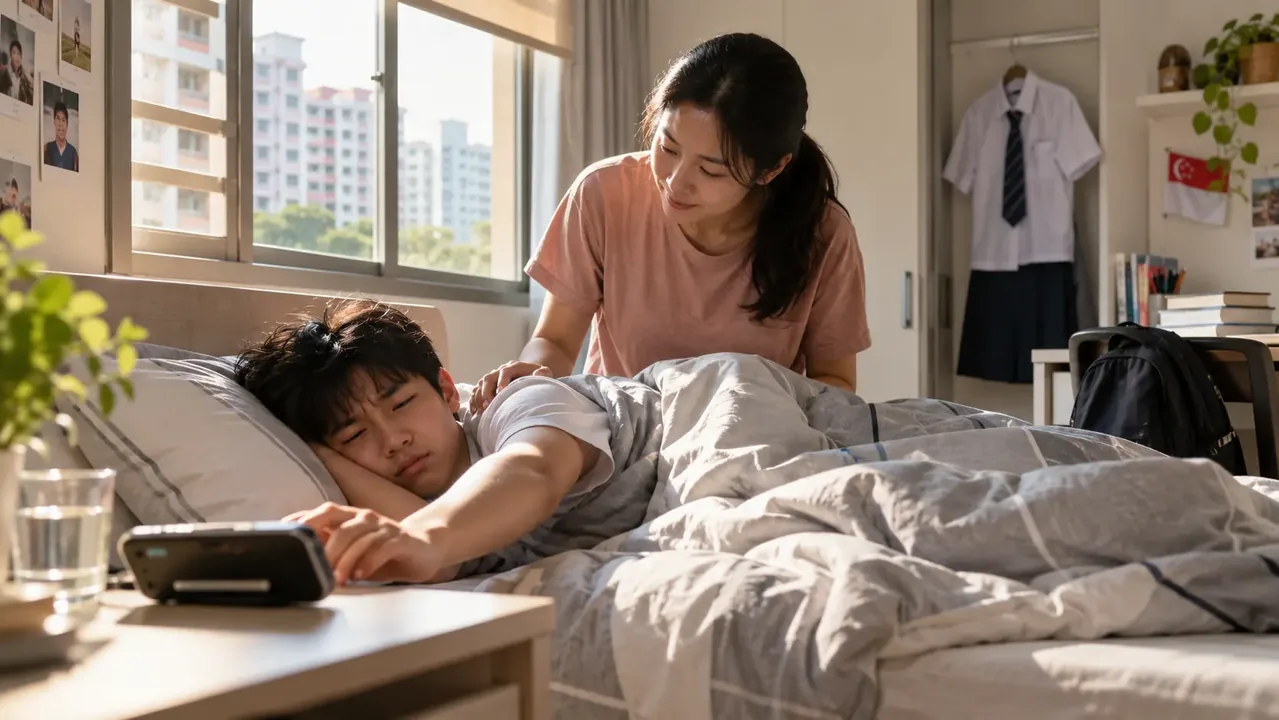
It is incredibly common to view a child who refuses to get out of bed at 6:00 AM as simply being defiant, lazy, or disorganised. When you are rushing to ensure they catch the school bus or make it to the parade square by 7:20 AM, the morning routine easily devolves into a stressful battle of wills that drains your energy before the day even begins. But behind the groans and the pulled-up blankets, the resistance is rarely a behavioral issue; it is almost always a clash between Singapore's early school hours and your child's underlying biological and environmental realities. This article breaks down the reasons behind your child's morning struggles and maps out practical, low-friction adjustments you can make to get the day started without the shouting match.
The Biological Reality
The first step to reducing morning friction is understanding that your child’s body is actively working against early wake-up times, especially as they enter their pre-teen and teenage years.
- The Melatonin Shift: As children grow, they experience a natural, well-documented shift in their circadian rhythms. Their bodies begin releasing sleep inducing hormones much later in the evening compared to adults, naturally pushing their ideal "sleep window" deeper into the night.
- The Adult Equivalent: Because their sleep cycle is delayed, forcing a teenager awake at 6:00 AM is biologically equivalent to asking an adult to wake up at 3:00 AM, and expecting them to sleep at 9:00 PM is like asking an adult to go to bed at 6:00 PM. The extreme grogginess is a physiological response, not an attitude problem.
Recognizing this biological shift allows you to step back from treating morning grogginess as purely a discipline issue, helping you preserve the parent-child relationship while you focus on adjusting the physical factors you actually have control over.
The Comfort Trap & The Environmental Fixes
While we cannot rewrite a teenager's biology, we can address the physical environment. Modern bedrooms are perfectly engineered for deep sleep, which inadvertently turns the bed into a sanctuary that is physically jarring to leave.
- The Sensory Cocoon: The sharp contrast between a cold, air-conditioned room and the warmth of a thick blanket creates a physical cocoon. When the room remains dark and freezing, the brain receives zero sensory cues that it is time to transition into "wake mode."
- The Temperature Shift: You can easily reverse-engineer this environment. Schedule the air-conditioning or standing fan to turn off exactly one hour before the alarm is set to ring. In Singapore's climate, the natural, gradual rise in room temperature will gently pull your child out of their deepest sleep cycles before the alarm even sounds.
- The Alarm Obstacle Course: Keeping the phone or alarm clock on the bedside table makes it too easy to hit snooze while half-asleep. Place the alarm (or multiple alarms) across the room, requiring the physical act of throwing off the covers and standing up.
Pro-tip: If your child is tuning out multiple alarms, try switching up the ringtone every few days so their brain doesn't get used to the sound.
By systematically disrupting the bedroom's physical comfort, introducing a spike in heart rate and a change in ambient temperature, you force their body to naturally break sleep inertia without needing to nag them out of bed.
The Digital Saboteur & The Audio Compromise
Even the most cleverly engineered morning environment will fail if your child is profoundly sleep-deprived. Often, late-night phone usage is the culprit, but the underlying reason is rarely simple rebellion.
- Filling the Void, Not Defiance: When children are physically in bed but biologically wide awake, their brains naturally seek engagement. They frequently turn to their phones to pass the time or self-entertain simply because they genuinely cannot fall asleep yet.
- The Blue Light Cost: Unfortunately, the screen time backfires. The blue light suppresses whatever late-arriving melatonin they have, while algorithmic, infinite-scroll feeds keep their nervous systems on high alert.
- The Podcast Swap: Banning devices at midnight usually just sparks a fight. Instead, facilitate a sleep-friendly alternative: have them place the phone face down out of reach and play a podcast or an audiobook.
Swapping the active visual stimulation of a screen for the passive distraction of an audiobook satisfies their need for engagement, allowing their brains to wind down and actually achieve restful sleep.
The Hidden Anxiety (When It's More Than Just Sleep)
Sometimes, the chronic inability to get out of bed has nothing to do with circadian rhythms or screen time, and everything to do with what awaits them outside the bedroom door.
- The Avoidance Factor: If waking up means facing a day of intense academic failure, severe social isolation, or peer conflict, the bed becomes a psychological shield. The morning resistance transforms from physical tiredness into a symptom of deep dread.
If you suspect the resistance is rooted in a larger mental health hurdle rather than just bad sleep habits, it requires a much different, highly supportive approach. Often, these unseen hurdles stem from social pressures. To explore what your child might be facing, we break down the mechanics of ‘soft-bullying’ in our related article.
Setting the Stage for a Better Academic Day
Shifting the morning narrative from a daily battle to a systematic, predictable routine takes the pressure off both you and your child. Remember that environmental tweaks like AC timers and podcast swaps require consistency to form a habit; they might not work perfectly on the very first day. But establishing a calmer morning routine ultimately means your child arrives at school and sits down for their afternoon study sessions focused, regulated, and ready to learn.
If you are looking for academic support for your child, we built the MatchaTutor directory, the easiest way to find the best tuition centres (private tutors coming soon) in Singapore. You can use our platform as a free tool to easily filter, compare, and connect with tuition centres across Singapore.
Frequently asked questions
What should I check before blaming my child for oversleeping?
Look at actual sleep, not just the time they entered the bedroom. Note late homework, device use, waking during the night and daytime tiredness. HealthHub's sleep guidance recommends consistent routines and professional advice when parents remain concerned.
Will extra alarms solve the problem?
They may help with a forgotten alarm, but they do not explain why waking is difficult. Agree on a simple morning sequence and prepare school items the night before. Review the evening workload too; moving the alarm earlier is not a solution to a timetable that leaves too little time for sleep.
What should we change in the evening?
Try a predictable wind-down and regular sleep and waking times, including during holidays. Keep the sleep environment comfortable and avoid turning bedtime into another performance target. HealthHub's advice for school-age children offers practical steps for developing a consistent routine.
When should a doctor assess my child's sleep?
Ask for medical advice when persistent tiredness, snoring or disrupted sleep is affecting the day, even when bedtime appears reasonable. Keep a short record of sleep and waking patterns to share. HealthHub identifies these as concerns worth discussing, rather than assuming the child is simply unwilling to get up.